Thirsty, Tired, Wired
Singapore, Johor, Batam and the data centre boom
by Nicole LimThis February, 50 people protested outside a construction site in Johor’s Gelang Patah, Malaysia. They represented 1,000 residents living with “dangerously poor” levels of air quality due to construction dust, unable to carry out day-to-day activities.
Gelang Patah is an economically up-and-coming area in Johor Bahru that is well-connected to Singapore.
The construction involves a data centre being built less than a kilometre away from the closest residential property, operated by Chinese data centre operator Zdata Technologies. It is one of two that are developing new data centres in Gelang Patah; the other, Japan’s NTT Data Group, was not known to have started construction at the time of the protest.
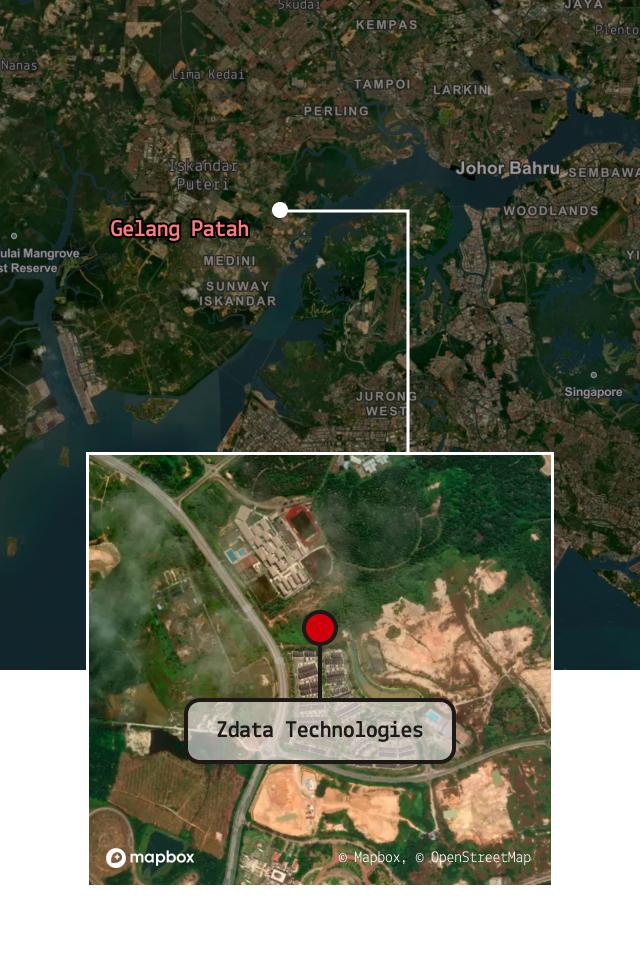
Protestors voiced concerns about the massive demand for water by data centres amid Johor’s frequent and severe water supply disruptions. The protest is the first of its kind in Malaysia, joining the global backlash against the environmental impact of data centres.
Over the last four years, Malaysia has experienced a data centre boom. The southern state of Johor in particular has emerged as Southeast Asia’s fastest growing data centre hub, with over S$53 billion in investments approved as of mid-2025. Zdata Technologies joins a host of other operators in Johor.
Johor’s data centre growth story is a direct consequence of spillover demand from Singapore.
Singapore, a global hub for business and Asia Pacific headquarters to many international MNCs, experienced a boom in data centre demand in the late 2010s when these companies began migrating to the cloud. Digital workloads such as email correspondences that used to be stored physically within company offices, were now moved “online”—that is, offloaded to data centres located around the city fringes. Singapore became a hotspot for data centres, with data centre capacity growing five times over 200 megawatts (MW) in 2015 to over 1,000 MW, or 1 gigawatt (GW) by 2020.
Even before generative artificial intelligence (genAI) became mainstream, 1 GW capacity already accounted for 7 percent of Singapore’s electricity needs back in 2021. With no natural resources and a heavy dependence on importing fuels, the country has to carefully manage its resources. The government imposed a moratorium in 2019, temporarily suspending the building of data centres. This led data centre operators to panic.
Singapore responded by signing economic partnerships with and directing attention to special zones in Johor and Batam. Press releases by Singapore’s Economic Development Board noted the “complementary” synergies that Batam and Johor offer.
In 2021, almost as a gesture, Singapore government-linked company Keppel built a 10 MW data centre in Johor. This first major, modern, customised data centre signalled that the region was a suitable proxy for Singapore. This move was quickly copied by other operators, says Paul Mah, an independent tech commentator based in Singapore. This included Chinese GDS holdings, now known as DayOne International.
The pitching of Johor and Batam as alternatives to Singapore is hardly a new concept. Back in 1989, then-Prime Minister of Singapore Goh Chok Tong established the SIJORI Growth Triangle, a cluster between Singapore-Johor-Riau in which Johor and Riau would take on the lower-skilled labour intensive work that Singapore was attempting to move away from. Riau is the group of islands that Batam belongs to.
This act of “offloading” by Singapore to neighbouring countries was later coined the “Singapore+1” strategy—a term used to refer to the “China+1” strategy where lower value work like manufacturing is shifted to surrounding countries.
As an electricity-producing state, Johor’s electricity rates are significantly cheaper than Singapore’s, at 12.76 to 17.22 Singapore cents per kWh compared to 30.49 Singapore cents per kWh. A square foot of land in Johor’s Sedenak Tech Park costs S$5.12, while a square foot of land in Singapore’s Tai Seng costs about S$6,000.
“The characteristic of data centre [operators] is that they tend to cluster. Johor is not monolithic [in its built], it is a parallel track [to Singapore],” says Mah. These clusters create a "sticky", self-reinforcing ecosystem that often evolves into a “data centre hub”, spanning about 50km wide—the exact radius of SIJORI.
Anything outside of a radius of 50–100km can result in delays in the transmission of data to customers—whether in terms of a lag for a TikTok user, or delays in important workloads for TikTok's parent company, ByteDance. For mission-critical workloads such as remote surgery or autonomous vehicle driving, an even smaller radius of up to 40km is crucial to ensure safety and absolute data accuracy.
According to data we gathered, data centres in SIJORI have multiplied by at least nine times in the last 20 years to over 2,000 MW of combined capacity today.
To attract even more foreign direct investment, Johor became a business-friendly environment almost overnight. For example, operators enjoyed a 100 percent exemption on taxes, such as property and income tax. State-owned utility company Tenaga Nasional Berhad also launched the Green Lane Pathway in 2023 to accelerate electricity supply options for data centres.
By the end of 2024, there were between 12 to 16 live data centres in Johor. In 2021, Johor had 10 MW of live IT capacity; this grew to over 900 MW as of end-2025, according to internal research by market intelligence firm DC Byte.
It is worthy to note that Batam has not enjoyed the same successes. One operator who purchased land in both regions during Singapore’s moratorium said that it began building in Johor first as regulatory approvals were quicker.
But building in all three countries is an important risk management strategy for operators, as they can hedge against political instability or power grid outages. Batam therefore has seen an uptick in data centre investments and builds in the last year or so.
As of late 2025, Batam’s Nongsa Digital Park has seven operating data centres with 12 more being built up, though some reports have placed these numbers higher, with 15 currently operating and 10 to 18 more underway. But Batam remains a “blank slate”—whether operators can successfully manage high capacity requirements remains to be seen.
Data centres are physical buildings that look identical to logistics warehouses. They usually house rooms containing rows of IT equipment, like servers, routers, and switches. Most online activities, such as ordering food delivery, streaming a show, or asking GenAI a question requires a physical data centre to process, store, and distribute that data.
The electricity used to power these data centres produce heat. Water is needed to cool these facilities and prevent them from overheating.
An AI data centre is a specific type of data centre which consumes far more electricity and water.
AI models involve the processing of astronomical amounts of data and the performance of complex mathematical operations all at once, continuously. This means that an AI data centre is typically about 50 MW to over 500 MW, with many new, massive AI superclusters exceeding 500 MW to reach 1 GW.

Data centre hubs like SIJORI have mushroomed all around the world in recent years, and are evolving into AI data centre superclusters because of the pace at which computing capacity is increasing. This exponential growth is hardly able to be sustained by current types of energy production, so the few companies at the forefront of AI innovation have begun investing in nuclear energy. While considered a more concentrated, reliable, and efficient power source, nuclear power is not without its controversies.
As Singapore’s 2019 moratorium and the Gelang Patah protest made clear, the region is struggling to juggle incoming data centre capacity with environmental and resource management.
As shown above, water and power requirements for just 1 MW of data centres alone can sustain over 76,000 homes and fill over 36,000 residential pools annually. These figures do not account for the fact that the generation of power also requires tonnes of water for its own cooling, and that most power generators do not work at full efficiency. The loss of power due to inefficiency means that massive amounts of fossil fuels are burned, mined, transported, and refined, only for the resulting electricity to be wasted rather than utilised.
At the onslaught of building excitement, operators in Johor were found to have significantly overestimated their electricity needs. Collectively, they had asked for over 1.2 GW of electricity but only consumed slightly over 600 MW as of June 2025. The environmental danger that comes with such speculative demand means that twice the infrastructure and resources have been allocated for something that does not exist, and will now go to waste.
For Johor, this reality combined with decades of industrialisation, intensive land reclamation, and urbanisation, means a further strain on an already fragile environmental ecosystem.
It is not uncommon to hear of cases of illegal waste dumping in rivers, and residents having to seek medical attention for dizziness and breathing difficulties.
The Malaysian authorities are keenly aware, and are now regulating the industry more closely. Weeks after the Gelang Patah protest, Prime Minister Anwar Ibrahim announced that all new applications for data centres unrelated to AI have been stopped. However, most of the committed data centre capacity in Johor is dedicated to storage and social media, with AI-workloads still an incoming demand.
Stricter evaluation criteria for water applications by data centres have also been implemented. As of early 2026, the state requires that operators use at least 85 percent of power it declared in its first four years. A penalty of S$2.74 per KW of shortfall will be applied accordingly.
Some operators have come up with their own environmental solutions. When Malaysia announced in August 2024 that it would start introducing guidelines for water and power usage effectiveness for data centres, DayOne International announced its own initiative to treat raw water from Tebrau River to cool its data centres in Kempas Tech Park. That operators are willing to collaborate with authorities signals that Johor remains a hot market of choice for them.
DC Byte analyst Vivian Wong observes that the momentum of data centre operators building in Johor is “still so strong” after a few years. Typically, markets experiencing such booms should by now show some cracks, yet Malaysia’s power grid has stood the test of time, Wong notes.
Two operators—DayOne International and Bridge Data Centres—account for at least 58 percent of Johor’s current live IT capacity, and will add over 40 percent more in the future. While Bridge is now owned by a US infrastructure firm, it historically merged with a Chinese operator in 2019, while DayOne rebranded from GDS Holdings, a Shanghai-owned company. The act of distancing oneself from one's Chinese origins is part of a decoupling trend that many Chinese firms are using amid geopolitical scrutiny over China.
China’s dominance in the data centres market in Johor can be traced back to the US-China trade war in 2018, when China was actively looking outside of the country into Southeast Asia to reduce risk. This was used by many companies such as ByteDance, which DC Byte says is the biggest customer of Chinese data centre operators in Johor currently.
Unlike the three American tech giants—Google, Microsoft, and Amazon—that typically build their own proprietary data centres, Chinese companies usually assign the job to a third-party operator, such as DayOne. The responsibility to deliver a complete and working data centre falls on operators, with penalties if they are unable to deliver. Chinese operators are known for being the fastest builders—completing projects as quickly as in nine to 12 months.
In June 2025, DayOne secured RM15 billion (S$4.82 billion) in green infrastructure financing: Malaysia’s largest bank Maybank committed RM2.5 billion (S$810 million), while Singapore’s OCBC acted as joint coordinators, green finance advisors, and Shariah (Islamic financing) advisors. This is exemplary of China’s presence in the region: a careful navigation of local regulation and political sensitivities through joint ventures and partnerships with banks, operators, and governments.
While it might seem like China’s influence over the region is disproportionately large compared to local or other global players, a closer look reveals the dominance of Western technology players. By country ownership, the US still owns the second-highest number of data centres in the region (after Singapore), thanks to Amazon, Microsoft, and Google, who all have regional headquarters in Singapore. AI companies such as OpenAI have also established their Southeast Asian footing in the city-state.
For Johor and Batam, local ownership of data centres is still in the minority. This draws questions on who ultimately benefits or loses from the development of these data centres.
Within the data centre supply chain, there are various players, and some may overlap.
For example, Microsoft owns its own data centre infrastructure called Azure, which it often builds, designs, and operates on its own. It also typically finances the build of its Azure data centres through internal company resources. Microsoft Azure can also be interchangeably called a “hyperscaler”, a term for large-scale cloud service providers. It is worth noting that these rules are not entirely set in stone. Microsoft has also outsourced builds to other third-party builders, and Chinese hyperscalers like Alibaba are also capable of self-build.
Could the pragmatic Singapore state pave the way for how the region balances data centre growth and resource management?
In 2022, Singapore launched a call for applications to grant 80MW new data centre capacity for “calibrated and sustainable growth” of data centres in Singapore.
Equinix, one of the four operators chosen, proposed green initiatives such as advanced liquid cooling technology, lower-carbon building materials, energy-efficient water-cooled chillers, and rainwater harvesting.
In May 2024, Singapore announced plans to build up to 300 MW of “green data centres”. Later in October 2025, it announced that a 700 MW green data centre park would be built over 2 hectares of land on Jurong Island, a reclaimed island off mainland Singapore that is typically unreachable by everyday Singaporeans and once the home of Indigenous Orang Laut.
A second call for data centres was announced in December 2025, with even more stringent requirements involving the use of green energy and “best-in-class” energy efficiency.
“I’m not aware of anywhere [else] in the world that sets this high a bar as a regulatory policy,” says Mah.
But the case of Gelang Patah shows that the environmental bill must ultimately be paid. There is also no guarantee that the green initiatives currently being planned will be effective.
For example, it is not certain if Singapore can fulfil its ambitions.
Wong from DC Byte says that operators may need more convincing before agreeing to move to Jurong Island. For one, the supply chain for renewable energy for the 700MW project on Jurong Island does not yet exist. “Singapore wants to do renewables, but we don’t have it [yet],” says Mah. DC Byte estimates that the earliest build of a data centre on Jurong Island will happen in 2029 or 2030.
All three countries seem keen to collaborate to ensure their economic success. This makes sense, as together they become a top 10 data centre destination. Yet despite regional proximity, things seem to be moving in silos. The weight of the cloud continues to hang heavy.
This story is part of the Dirty Data, a collaborative project by the Environmental Reporting Collective (ERC). Kontinentalist is one of the 11 reporting partners working with ERC to examine the impact of data centres in the region.
This story was updated on 14 May 2026 to reflect the following:
- The line "Data centres are physical buildings that look identical to logistics warehouses. They usually house rooms containing rows of IT equipment, like servers, routers, and switches." was included.
- A previous version of the story said "Anything outside of this 50km radius means delays in transmission of data, widely considered as a high-stake failure in the industry." For mission-critical workloads, the radius shrinks to 40km. For non-mission critical workloads that still require low latency, the radius is between 50–100km. The line was updated to be more specific and accurate.
- The line "For example, operators enjoyed a 100 percent exemption on taxes such as property and income tax. State-owned utility company Tenaga Nasional Berhad also launched the Green Lane Pathway in 2023 to accelerate electricity supply options for data centres." was included to elaborate on the business-friendly transformation of Johor.
- The line "For Johor, this reality combined with decades of industrialisation, intensive land reclamation, and urbanisation, means that an already fragile environmental ecosystem may soon turn into an ecological disaster." was updated to remove the mention of a potential ecological disaster.