What's in an Asian name?
Taking a look at the diversity and richness of Asian naming conventions
by Jerald LimOur names are a core part of us. They are how our loved ones refer to us, and the first thing we share with a stranger. They are often imprinted from birth and follow us even after we pass on. It can be painful when we are forced to change or adapt our names.
Many Asian names don’t fit “default” naming conventions. This means that filling out a simple form—such as immigration arrival cards or job applications—can become a tiring exercise.
Forms like these often follow the Western naming convention of first name followed by a last name. Many forms also do not support elements like punctuation and diacritics (letters with accents, like ‘é’). This erases the diversity of sounds and tones found within many languages. For convenience, some people end up having to force-fit their names, at times nonsensically so. Sometimes, these changes are still flagged as an error, leading to complications.
Beyond being an inconvenience, these rigid systems reduce the richness of meaning and beauty behind names drawn from long-standing historical, cultural, and political significance.
Naming conventions are norms and patterns around how people are named. They can be understood as a combination of where names originate from, and how they are ordered.
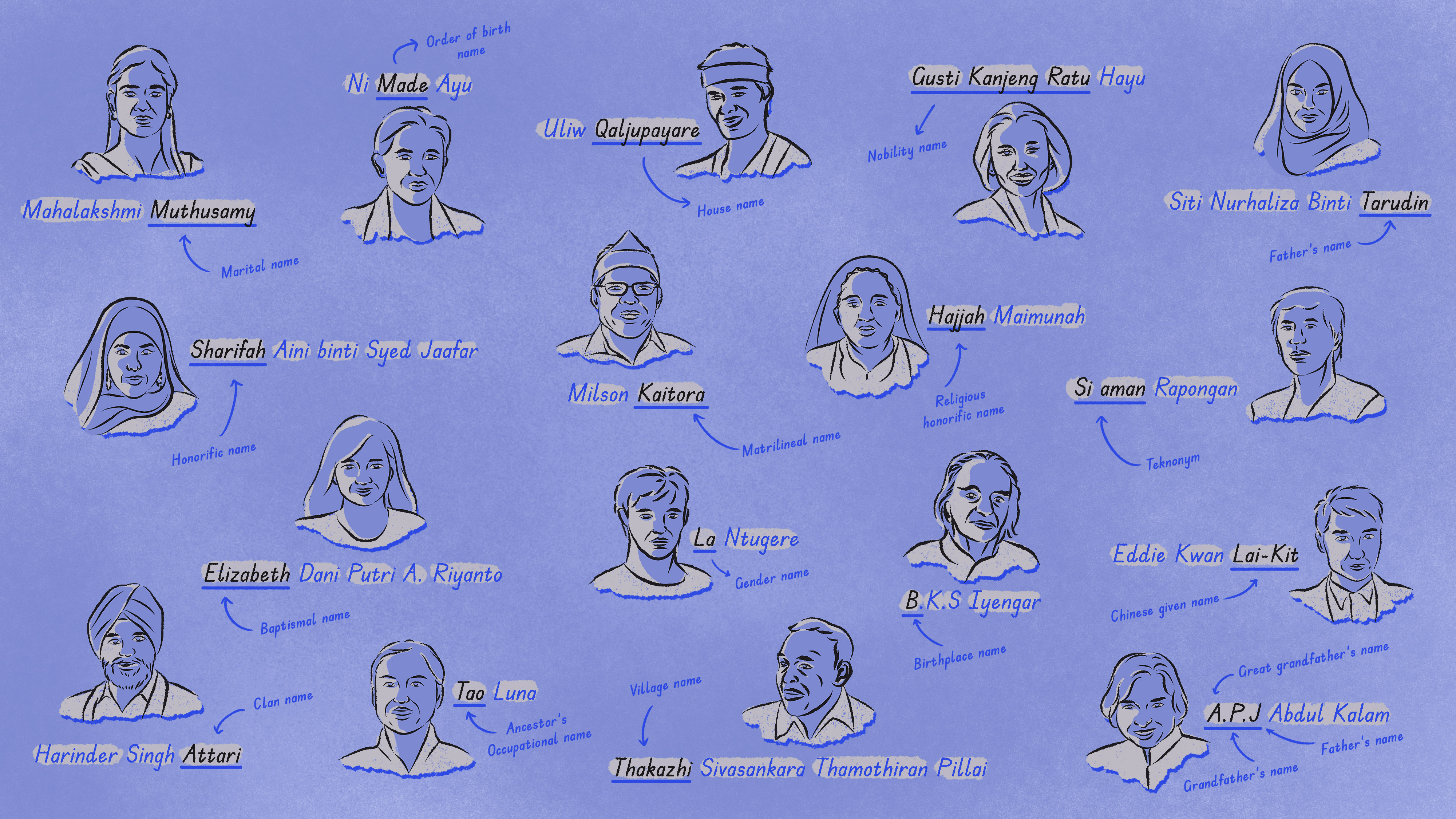
Asian naming conventions are diverse. Within one’s full name, each name originates from a wealth of communal significance, from religious markers to birth order.
Let's first take a look at the origins of some of these names:
Additionally, individual names are ordered into full names in various ways across cultures—a family name might precede a given name in one culture but follow it in another.
Western naming structures commonly resemble this standardised form:

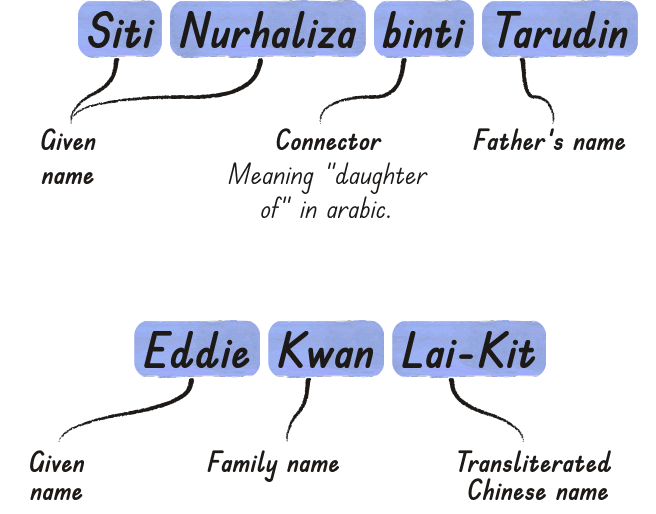
Some full names contain additional connecting elements like the nasab (an Arabic indicator of patronymic relations in Malay or Muslim names, like “binti” here). Others may only consist of a single name, also known as a mononym (more common in the past, but still practised in Bhutan and Afghanistan).
Family names may be abbreviated and include periods. Diacritics are used to convey tone and pronunciation (in Mandarin Chinese, lái and lài are pronounced differently; see Complexity Science Hub’s brilliant breakdown of Mandarin pronunciation here).
What might your name look like if it stemmed from the wealth of origins and order in Asian naming conventions?
Try out the speculative exercise below. Here are some questions you might wish to ponder whilst playing with it:
- Which of these speculative names resonate best with you and why?
- What other aspects of your life would you want to be reflected in your name?
- What does your name reveal about you and your lineage?
Feel free to answer however you like. Your answers only live in your web browser and are not collected by us.
Asians and others with non-Western names living in the West have faced discrimination in the job market primarily on the basis of their names, as various studies have found.
In a 2016 study investigating the employment opportunities for Muslim migrants in Germany, researchers sent out over a thousand job applications, using photos of the same person and identical work experiences. Only the applicants’ names differed.
They found that applications sent out with a German-sounding name (“Sandra Bauer”) got 50 percent more callbacks than applications sent out with a Turkish-sounding one (“Meryem Öztürk”).
These experiences happen in Asia as well. In a 2019 study done in Singapore, which has a majority Chinese population, researchers had 175 Singaporean Chinese undergraduates review resumes for a research assistant job.
Participants rated Malay applicants as less competent, less suitable for the job, and deserving of a lower salary as compared to Chinese applicants with the exact same qualifications. The same participants also rated White applicants as more suitable for the job and deserving of a higher salary compared to Chinese applicants. The researchers suggest that their results “demonstrate the strong negative effects of colonial mentality and colorism”.
In these environments, hiring or other selection committees should consider implementing name-blind practices. This means that names on applications should be hidden from reviewers and added back later in the process.
The reality of continued racial discrimination, whether through explicit or implicit biases, can incentivise or even necessitate the adoption of Western names. Asian students in Western countries continue to do this, for example.
Some people change their names to Western-sounding ones for other reasons. Some Chinese Hongkongers do this to cut through the formality of introductions in Chinese business culture. They feel that this allows them to develop warmer relationships more quickly, even amongst other Chinese Hongkongers.
Asian communities and individuals have changed their names for a variety of reasons.
Given that there are approximately 4.8 billion Asians in the world, perhaps more can be done to accommodate and celebrate the diversity of naming conventions. Some institutions have taken or are already taking steps to ensure Asian names are more widely understood and respected.
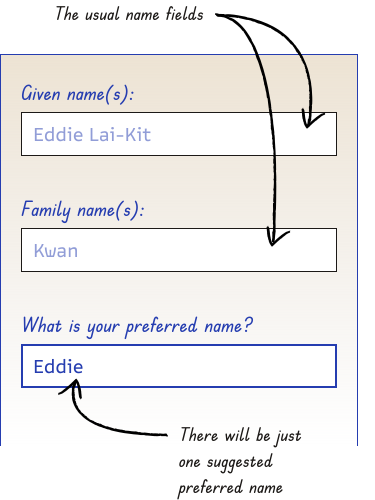
Thankfully, when it comes to forms, the fix can be as simple as using a single unified field for names.
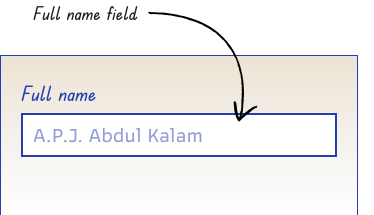
Using a single “Full name” field removes respondents’ frustration around figuring out how to (re)order names and which names to include or not.
Then if more specificity is required, having fields like “Preferred name” avoids assumptions of a singular “Given name” or a primary “First name”. In fact, naming a field after origins instead of order is generally a more inclusive practice. For example, asking for a “Family name” instead of a “Last name” helps those whose family names are not their last names know what information is required of them.
Nevertheless, form changes can only effect as much change as the structures of cultural acceptance around them allow for. Broader efforts to reduce discrimination and foster inclusivity need to accompany these changes.
Asian names are moored to a wealth of stories and histories and should be treated with more weight and curiosity, not lobotomised for convenience or uniformity.
To learn about further intricacies of Asian naming conventions, check out these resources:
- Indigenous Sight’s introduction to various Taiwanese Indigenous naming conventions
- The Palestinian Information Center’s coverage of the Palestinian tradition of naming children after places they were forced to leave
- Complexity Science Hub’s exploratory data visualisation of Pinyin, a notation system for Mandarin Chinese pronunciation
- Kontinentalist’s piece about the history and evolution of Han Chinese names
- Project Implicit’s Implicit Association Tests (IATs), which measure subconscious associations we might make between things like names and positive or negative traits